
Here, I am Math Aunty Demara, but from 8 am to 930 am, I am Sewaa Demara to black students in grades 4ish-7ish in a virtual homeschool academy Ubuntu Village lead by Kiya Green. And from 1 pm – 2pm, I am Ms. Demara to black students in the feeder school for upper grades 8-12, SĀHGE Academy lead by Arden Santana. Parents send their children for education that uplifts Black and African peoples and culture, so I am incorporating a couple different class rituals to ensure that my content is Hella Black. It’s been amazing and I want to share an activity that allowed for a beautiful segue into our study of linear equations.

On Mondays (or Tuesdays, respectively), we celebrate black mathematicians or work on activities that highlight Black or African culture (music, art, etc), people, socioeconomic status, and more. The week before we jumped into our study of slope, our Monday feature was Bob Moses, a civil rights leader and community organizer who believed that “Math is a Civil Right”. I had students read this article by Donna Curry. posted in Change Agent, an Adult Magazine for Social Issues. Since I’m working with a younger group of students, I always ask them questions that push them to go back to the reading and find key points. Here are the questions I asked (and collected in a Google Form).
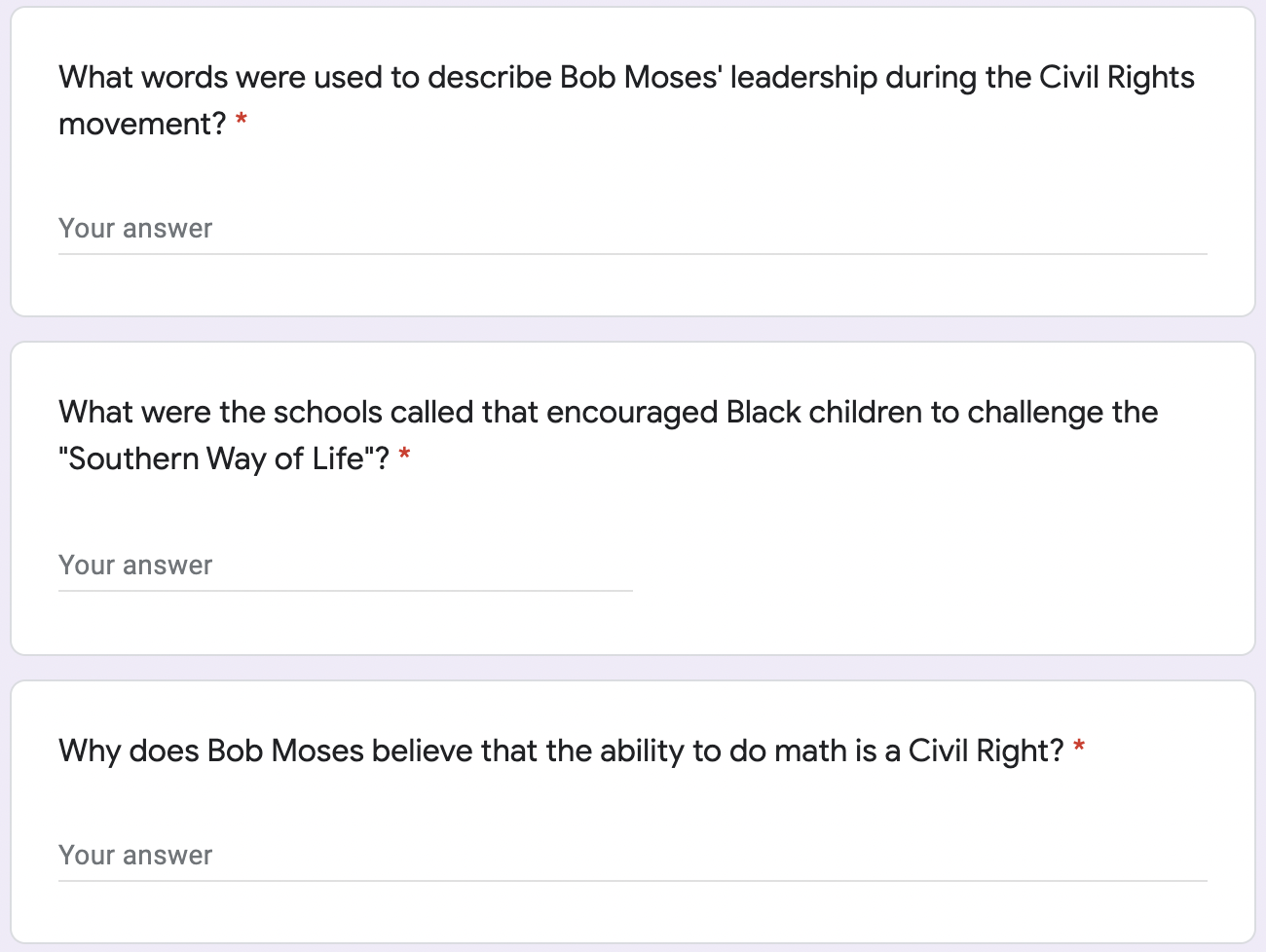
Some key discussion points that you can highlight to create a truly integrative learning experience – Bob Moses is described as a quiet leader, what does it mean to be a quiet leader? This is a time where you can highlight the qualities that make quiet people great leaders and boost up some of your students. (I co-created a course called Developing Leaders with a previous coworker Porscha Henson and the students were more deeply inspired and awed by examples of quiet leaders like Bayard Rustin. Contact me if you’re interested in hearing more about the class!)
Well, the following week was both the end of the quarter and the start of linear equations. In my message to students giving the final deadline for any missing work, I ended with my excitement for the rich applications of linear functions a quote from this Washington Post article on Bob Moses by Courtland Malloy.
Thanks for a great first quarter, let’s continue to do great math! I am excited about our exploration into slope (and eventually linear functions) because it allows you to study a lot of rich applications in business, music, graphic design, and more – because you start to quantify change!
A quote from an article (linked below) on Bob Moses who was last week’s Moor Math Monday feature:
“Bob believed that to make systemic change, you needed a sophisticated understanding of how systems work,” Cobb said. “Teaching algebra to Black middle school students would start them thinking in a deeper way about how systems and symbols operate and how they can be manipulated.”
Moses sometimes referred to the fight for civil rights as a marathon, not a sprint.
Let’s get it in quarter 2!
A follow up assignment will be to reflect on what could be meant by “how systems and symbols operate and how they can be manipulated.” Mathematically, I will cycle back to this quote when mentioning combining like terms, systems of equations, and different equations giving the same line – and highlight it when students make particularly keen observations when we mathematically study socioeconomic and civil issues.
So there you have it – a short, sweet way to introduce more Black mathematicians into the classroom AND set the stage for a classroom that uses math to study social matters, inviting rich discussions and paving the way for a more math-literate, anti-racist society. Thanks for reading and if needed, my contact info can be found here linktr.ee/mathaunty.

 Math Aunty
Leave a comment